⚡ Quick Answer
Fez isn’t a city with craft shops — it’s a city that is a workshop, and the best way to experience it is hands-on. Three bookable experiences stand out: a half-day rug weaving workshop at a traditional loom, a wool spinning session with the artisans who feed the city’s looms, and a natural wool dyeing workshop paired with a guided souk visit to the markets where it all gets sold. Add the free spectacles — the Chouara tanneries, the coppersmiths of Place Seffarine — and you have the deepest craft immersion in Morocco.
Every visitor to Fez watches the artisans: the dyers at their vats, the weavers at their looms, the coppersmiths hammering in Place Seffarine. But watching through a shop doorway — usually thirty seconds before someone tries to sell you the finished product — barely scratches what this city has to offer. Fes el-Bali is the largest living medieval craft economy on earth, and the difference between seeing it and doing it is the difference between a photo and a memory.
A newer generation of bookable workshops now opens the real thing to travelers: hours at the loom or the dye vat with working artisans, not staged demonstrations. Here are the standout experiences — what each involves, who it suits, and how they fit into a 2-3 day Fes visit.
1. The Rug Weaving Workshop: Half a Day at the Loom
Moroccan rugs are the souvenir everyone wants and almost no one understands — which is exactly why this half-day workshop is the smartest few hours you can spend in Fez. Working beside a master weaver at a traditional loom, you learn the knots, the patterns and their meanings, and just how many hours of labor hide in a single square meter. You leave with your own woven piece and — perhaps more valuable — the knowledge to judge quality and haggle fairly for the rest of your life.
→ Check dates & prices for the half-day rug weaving workshop
2. The Wool Spinning Workshop: Where Every Thread Begins
Before the loom comes the thread — and spinning is the craft the whole textile chain rests on. This workshop puts raw Rif wool in your hands and teaches you to card and spin it the way it’s been done here for centuries. It’s tactile, meditative, and surprisingly humbling: five minutes of lumpy, breaking yarn gives you permanent respect for every carpet in the souk.
→ Check dates & prices for the wool spinning workshop
3. Natural Dyeing + the Souk: The Full Circle
The most complete of the three: a hands-on session with natural dyes — indigo, saffron, henna, pomegranate — learning how the medina has colored its wool without chemicals for a thousand years, followed by a guided walk through the craft souks to see the finished spectrum hanging in the market. It connects everything: the plant, the vat, the thread, the stall. If you book only one workshop, this is the one with the widest lens.
→ Check dates & prices for the natural dyeing workshop & souk tour
The Free Spectacles (Don’t Skip These Either)
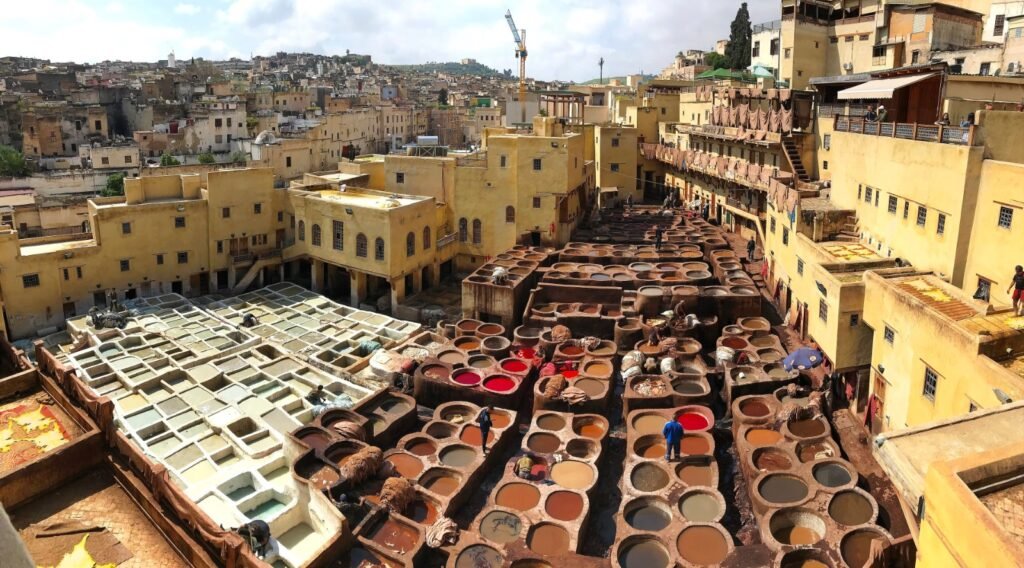
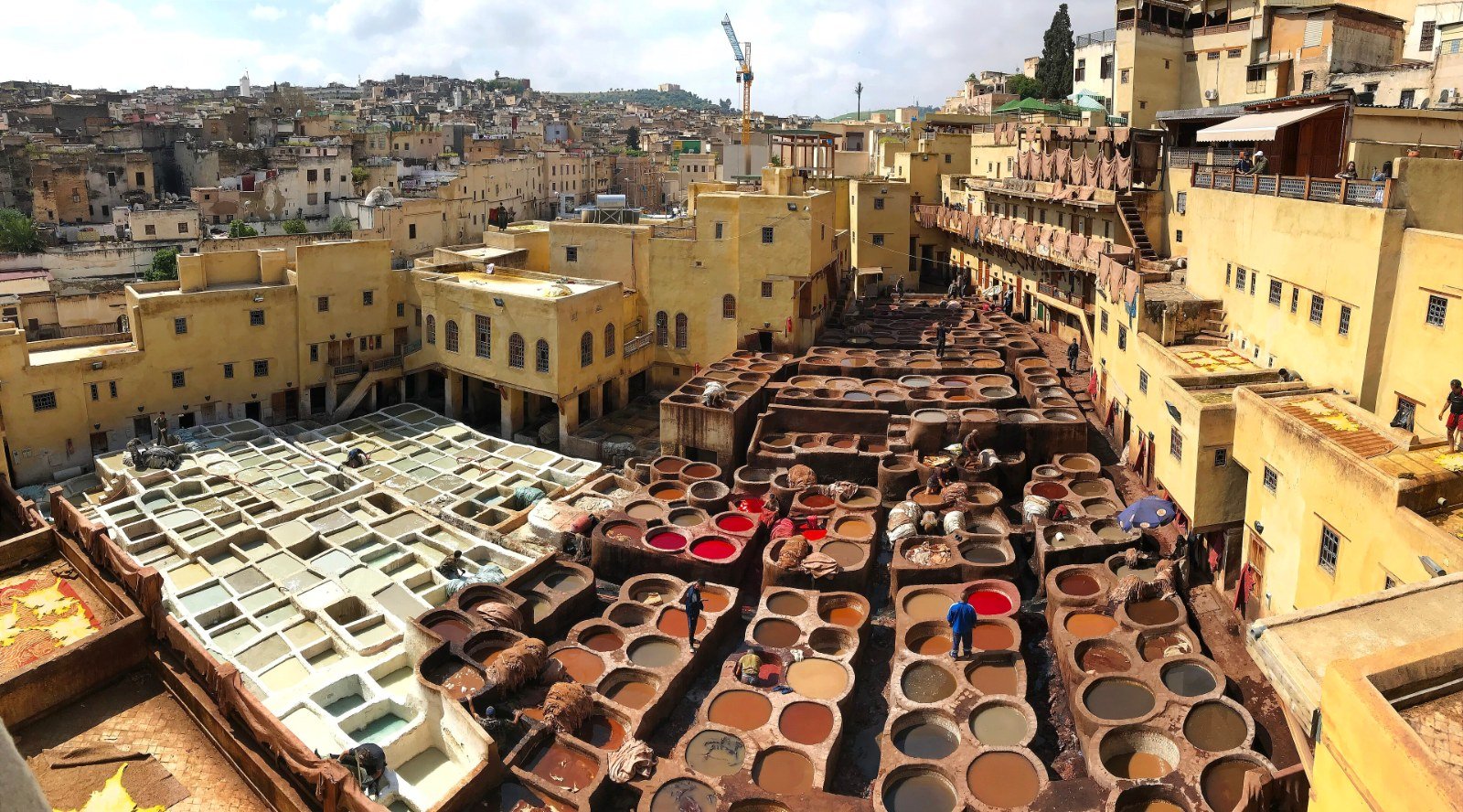
- The Chouara Tanneries — the most famous craft sight in Morocco: stone vats of dye worked exactly as they were in the 11th century, viewed from the leather-shop terraces (a small tip or an honest look at the goods is the fair price of the view).
- Place Seffarine — the coppersmiths’ square, where the soundtrack is hammers on metal and the pots being made are the ones Fassi kitchens actually use.
- The Nejjarine fondouk — the restored caravanserai housing the museum of wooden arts, the elegant indoor counterpart to the street craft all around it.
- The weavers’ and dyers’ lanes — keep your ears open as you wander: the clack of looms behind half-open doors is your invitation to look in politely.
💡 Smart Tips
- Book workshops for day two. Do the classic sights first (our Fes plan) — the workshops mean more once you’ve seen the finished crafts in context.
- Dress for work: natural dyes are natural, but they’re still dyes — wear nothing you’d mourn, and tie long hair back at the loom.
- Buy after, not before. The single best haggling upgrade in Morocco is shopping for rugs and textiles after a workshop — sellers recognize an educated buyer in the first thirty seconds.
- Photograph people with permission, always — artisans at work are generous with cameras when asked first, and stony when not.
- Staying over? Base yourself in or near the medina to be steps from the craft quarters — our area-by-area Fes guide explains the trade-offs.
- Heading north after Fes? Chefchaouen is the Rif’s own weaving town — its striped blankets make the perfect comparison piece, and the road there is easier than you think.
FAQ
Are the Fez artisan workshops worth it?
If you have any interest in how the medina actually works, yes — they turn the city’s most photographed scenes into something you’ve done with your own hands, and they permanently upgrade your judgment as a buyer of Moroccan crafts.
How long do the workshops take?
Plan on a half-day for the rug weaving experience and several hours for the spinning and dyeing sessions (the dyeing option includes the guided souk walk). All fit comfortably alongside sightseeing in a 2-3 day visit.
Do I need any experience?
None — the workshops are built for complete beginners, guided step by step by working artisans. Children old enough to follow instructions generally love the spinning and dyeing sessions; check age guidance when booking.
Can you visit the Fez tanneries for free?
Effectively yes — the classic Chouara viewpoints are the terraces of the surrounding leather shops, where a small tip or a genuine look at the merchandise is the expected courtesy. Beware the “free mint sprig” that sometimes arrives with an invoice.
What crafts is Fez famous for?
Leather above all (the tanneries), plus rugs and textiles, zellige tilework, copper and brass, carved cedar, and blue Fassi pottery — most of them still made inside the medina by the same methods the city has used for centuries.
🗺️ Fez is the workshop. The North is the road trip.
After the looms and the dye vats: Chefchaouen’s blue lanes, the Rif’s waterfalls, UNESCO Tétouan and two coastlines, all within four hours. Our Northern Morocco Road Trip Guide maps the whole journey — day-by-day plans, our real venue picks, GPS for every stop. Get the guide here →