⚡ Quick Answer
Two days covers Fes’s essentials: Fes el-Bali (the world’s largest car-free medina, UNESCO-listed), the Chouara tanneries, the Bou Inania Madrasa, the gates of Al Quaraouiyine — the world’s oldest university — and sunset at the Marinid Tombs. A third day adds the Roman ruins of Volubilis and imperial Meknes. Fly into Fes-Saïss (FEZ) — a major low-cost hub with direct flights from across Europe — and when you’re done, the blue city of Chefchaouen is 4 hours north: the start of the country’s most underrated region.
Let’s be upfront: our home turf is Northern Morocco — Tangier, Chefchaouen, the Rif and the coasts. But nearly half the travelers heading to our region start in Fes, and the question lands in our inbox constantly: how many days does Fes need, and what actually matters there? So here’s our honest gateway guide — the essentials done right in 2 or 3 days, the institutions worth your money, and the smartest way to continue north afterward.
Getting to Fes
By air: Fes-Saïss Airport (FEZ), about 25 minutes south of the city, has grown into one of Morocco’s busiest low-cost gateways — Ryanair, Air Arabia, Transavia and others fly direct from dozens of European cities, often at prices that undercut Marrakech. Pro move for Northern Morocco travelers: fly into Fes and out of Tangier (or vice versa) — the two airports bracket the perfect one-way route with zero backtracking.
✈️ Check Flights to Fes (FEZ)
Compare direct low-cost routes from across Europe — and check Tangier (TNG) alongside for the fly-in/fly-out loop.
Search on Kiwi → Compare on Aviasales →By train: ONCF trains link Fes with Rabat, Casablanca and (with a connection to Al Boraq’s high-speed line) Tangier. By bus: CTM connects Fes to everywhere, including the crucial run north to Chefchaouen. Data on arrival: install an eSIM before you fly — our full connectivity guide explains why it saves your first morning.
Day 1 — Fes el-Bali: The Medieval Deep End
- 🌅 Enter at Bab Boujeloud, the “Blue Gate” (blue ceramic facing out, green facing the medina) — and accept that you will get lost in the 9,000 streets behind it. That’s the point: Fes el-Bali is the world’s largest car-free urban area, essentially unchanged since the Middle Ages, where donkeys still do the deliveries.
- ☀️ Bou Inania Madrasa — the grandest of the city’s Quranic colleges (14th century) and fully open to non-Muslim visitors: carved cedar, marble courtyard, dizzying zellige.
- 🕐 Lunch at Café Clock — yes, the original: the beloved cultural café whose Chefchaouen outpost we recommend up north was born here in Fes. Camel burger, rooftop, cross-cultural programming — a genuine institution.
- 🌤️ Al Quaraouiyine — founded in 859 by Fatima al-Fihri and recognized as the world’s oldest existing university. Non-Muslims can’t enter the mosque itself, but the gateways offer glimpses of the courtyard — and the neighboring Nejjarine fondouk (museum of wood arts) and Attarine Madrasa complete the golden triangle of Fassi craftsmanship.
- 🌇 The Chouara Tanneries — the iconic stone vats of dye, viewed from the leather-shop terraces above (a small tip or a fair look at the shop is the entry fee; the offered mint sprig helps with the smell). Go late afternoon when the light hits the pits.
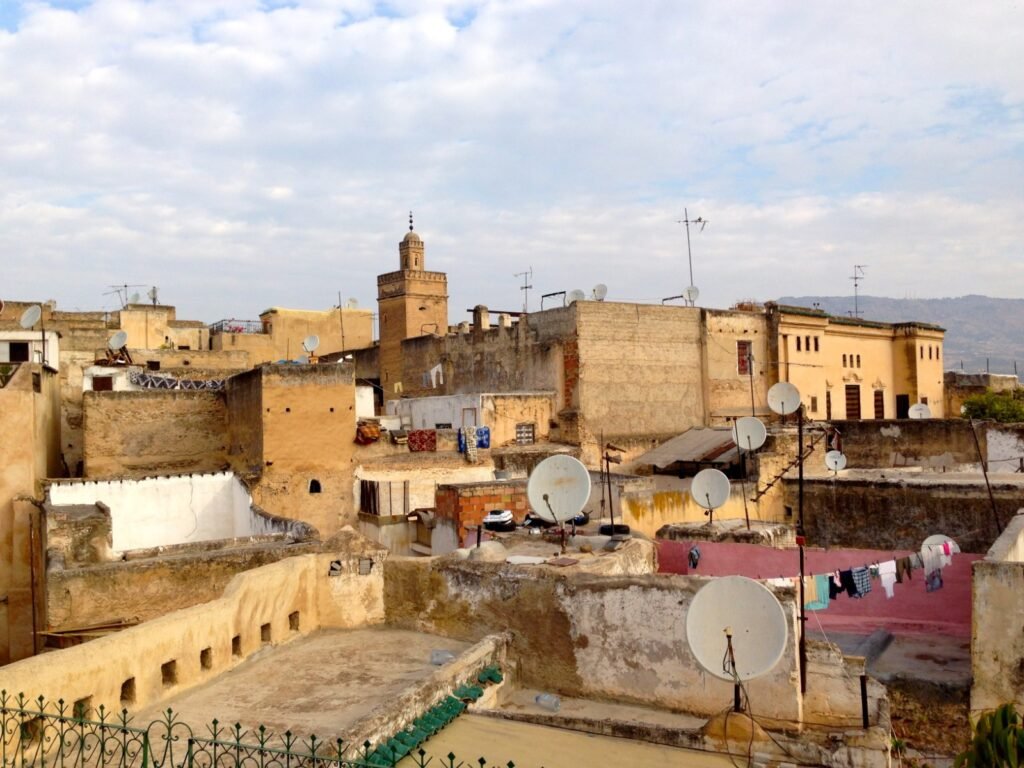
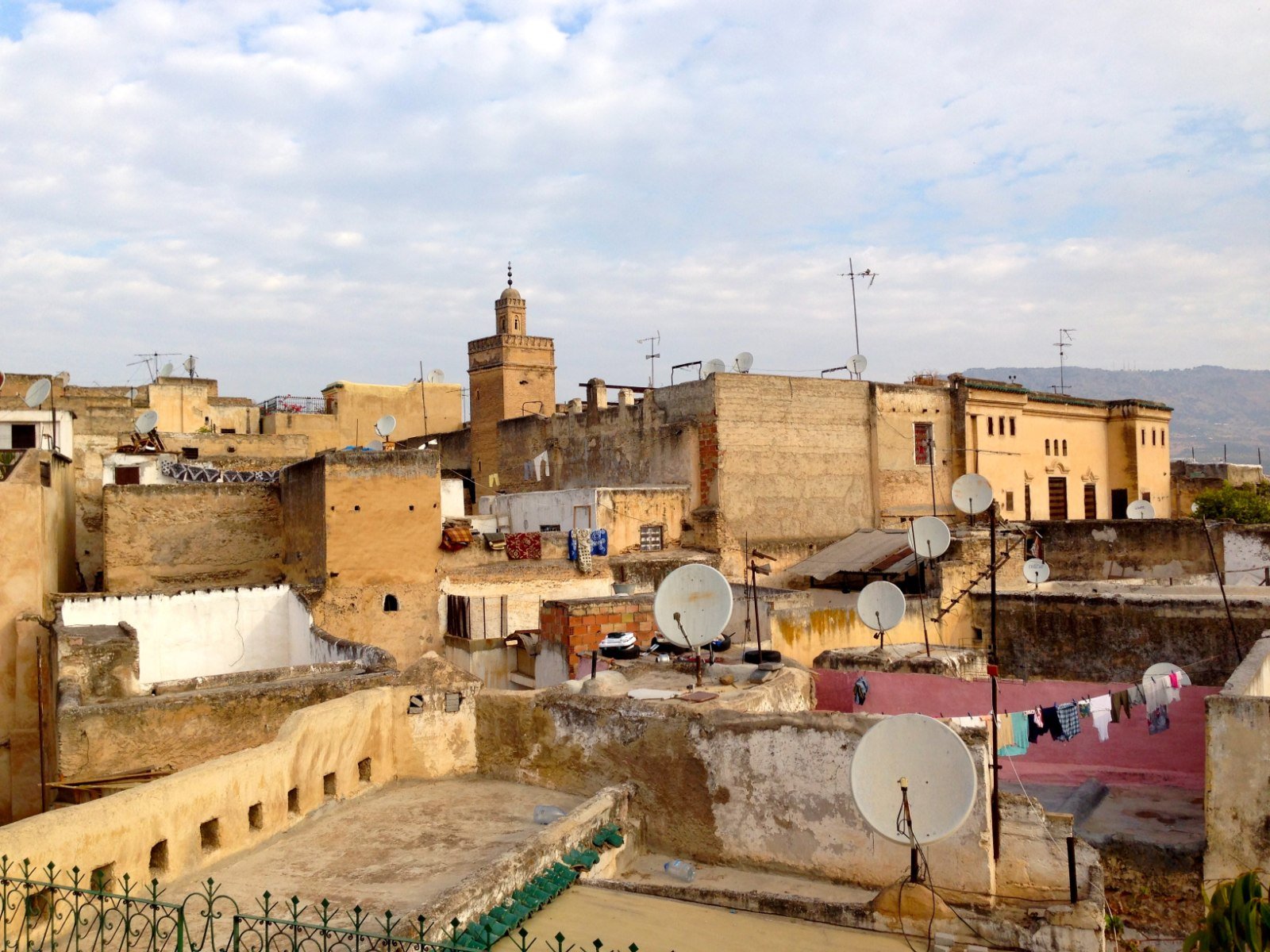
- 🌆 Sunset at the Marinid Tombs — the short climb north of the medina delivers the full panorama: ten thousand rooftops, a hundred minarets, the call to prayer rising in stereo. The classic Fes moment.
Day 2 — Palaces, Gardens & the Other Fes
- 🌅 The Royal Palace doors — Dar el-Makhzen is closed to visitors, but its monumental brass gates are the city’s finest photo-op. Continue into the Mellah, the historic Jewish quarter, with its distinctive wrought-iron balconies.
- ☀️ Jnan Sbil Gardens — the restored royal gardens between the old and new cities: fountains, bamboo, and the shade every medina explorer eventually craves.
- 🕐 Afternoon deep-dive: return to the medina for the souks you rushed past — the copper beaters of Place Seffarine, the spice and honey markets — or take a guided walking tour to decode what you’ve been seeing. A self-guided audio tour is the sweet spot between freedom and context.
- 🌙 Evening: dinner in a restored riad — the Fassi table (pastilla above all) is one of Morocco’s great cuisines, and the palace-restaurant experience is worth doing once, properly.
🎧 Decode the Medina at Your Own Pace
A self-guided audio tour turns Fes el-Bali’s chaos into stories — no group, no schedule, just you and twelve centuries.
Browse Fes Audio Tours →Day 3 (Optional) — Volubilis & Meknes
The classic add-on: the Roman ruins of Volubilis — Morocco’s finest ancient site, with mosaics still in place under the open sky — paired with Meknes, the most compact and relaxed of the imperial cities (Bab Mansour, the royal granaries). It’s a comfortable day trip by grand taxi, private driver or organized tour.
🚌 Day Trips & Tours from Fes
KKday runs Volubilis & Meknes day trips, medina experiences, and multi-day circuits north toward Chefchaouen — transport, guide and pickup included.
Browse Tours from Fes →💡 Smart Tips
- The “helpful guide” routine: unofficial guides materialize at Bab Boujeloud. A confident “la, shukran” and steady walking ends it — or hire an official guide through your riad and get the real thing.
- The tannery terraces are shops. The view is the product — either tip a small note or give the leather goods an honest look. Both are fair; pretending neither is not.
- Watch the “free mint.” As locals note, a sprig offered “free” at the tanneries sometimes comes with an invoice attached — bring your own or accept knowingly.
- Fes is steeper than it looks. The medina is a bowl: every wander ends with a climb. Good shoes, water, patience.
- Dress for the culture: shoulders and knees covered gets you smoother interactions everywhere, and it’s required for the madrasas.
- Heading north after? Don’t backtrack — the road to Chefchaouen opens the whole region, and our 3-day Northern route picks up exactly where Fes ends.
FAQ
How many days do you need in Fes?
Two full days for the city itself — the medina deserves unhurried time — and a third if you want Volubilis and Meknes. Less than two days means rushing the very thing Fes does best: immersion.
Is Fes worth visiting compared to Marrakech?
Fes is the deeper, less commercialized experience: a working medieval city rather than a show. If you want atmosphere and authenticity over rooftop bars and crowds, Fes wins — and it pairs perfectly with the equally underrated North.
Is Fes safe for tourists?
Yes, with standard medina awareness: firm politeness with unofficial guides, agreed taxi fares, and normal care with valuables in crowds. The hassle is persistent but rarely more than verbal.
Can you fly directly to Fes?
Yes — Fes-Saïss (FEZ) has direct low-cost flights from dozens of European cities. Compare it with Tangier (TNG) when booking: flying into one and out of the other creates the ideal one-way route through Fes, Chefchaouen and the North.
What should you not miss in Fes?
The Bou Inania Madrasa, the Chouara tanneries at golden hour, the gates of Al Quaraouiyine, getting properly lost in Fes el-Bali, and the Marinid Tombs panorama at sunset. Everything else is a bonus.
🗺️ Fes is the prologue. The North is the story.
Four hours from the medina’s chaos: the blue calm of Chefchaouen, the Rif’s waterfalls, UNESCO Tétouan and two coastlines. Our Northern Morocco Road Trip Guide maps the whole journey — day-by-day plans, our real venue picks, GPS for every stop. Get the guide here →