⚡ Quick Answer
The easiest way to get data in Morocco is an eSIM installed before you fly — no kiosk, no passport, working data the moment you land (from around $5–15 for a typical trip; compare Morocco eSIM plans on Klook). The cheapest option is a local physical SIM from Maroc Telecom, Orange or inwi — tourist packs start around 30–100 MAD ($3–10) but require your passport and a store visit. Coverage in Northern Morocco is excellent on 4G in Tangier, Asilah and Tétouan; for Chefchaouen’s surrounding mountains and Akchour, Maroc Telecom has the strongest rural signal.
Nothing shapes your Morocco trip quite like having data from minute one: pulling up maps in the medina, messaging your riad on WhatsApp, translating a menu, ordering an inDrive. And nothing sours an arrival like discovering your home carrier wants $12 a day for roaming.
The good news: staying connected in Morocco is cheap and easy in 2026 — if you pick the right option before you arrive. Here’s the complete breakdown: eSIM vs local SIM, which Moroccan operator has the best coverage in the North, real prices, and the mistakes that leave travelers offline at the airport.
eSIM vs Local SIM Card: Which Should You Get?
Both work well in Morocco. The right choice depends on how you weigh convenience against price:
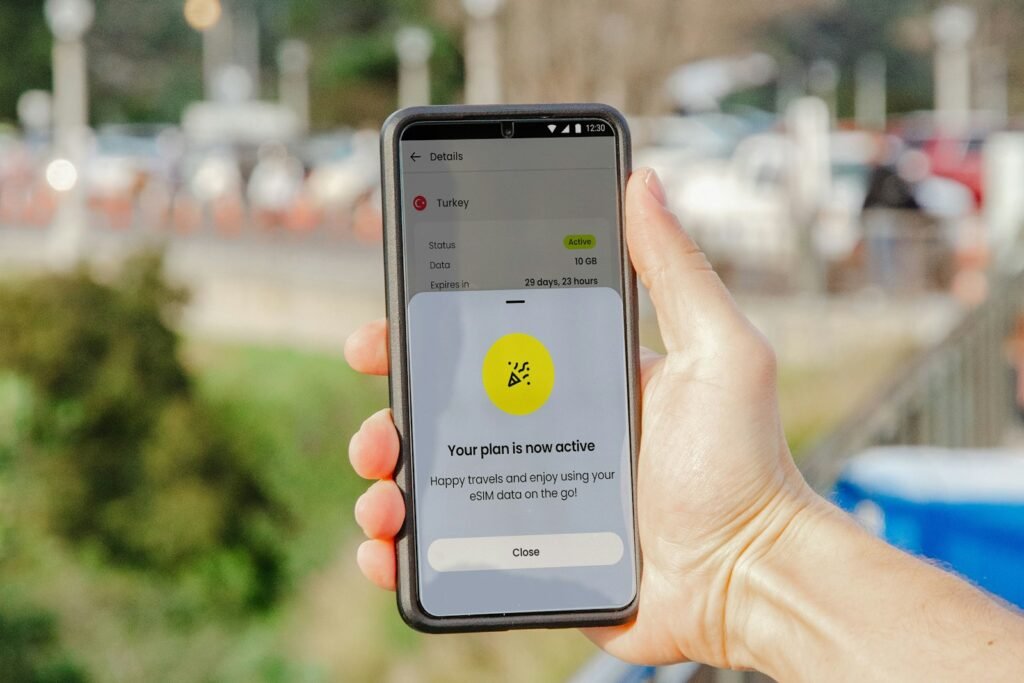
- Choose an eSIM if: you want data working the second you land, you’re arriving late or by ferry, your trip is under two weeks, or you simply don’t want to spend your first hour in Morocco at a phone kiosk. You install it at home in five minutes by scanning a QR code — no passport, no paperwork, and your home SIM stays in place for calls and 2FA texts.
- Choose a local physical SIM if: you want the absolute cheapest data (local packs offer the best price per GB in the country), you’re staying several weeks, or your phone doesn’t support eSIM. You’ll need your passport — SIM registration is legally required in Morocco — and a visit to an official carrier store.
📱 Get Your Morocco eSIM Before You Fly
Instant delivery by email, install in 5 minutes, data active the moment you land in Tangier. Plans for every trip length.
Compare Morocco eSIM Plans →Which eSIM Brand Should You Buy?
Dozens of providers sell Morocco eSIMs, and most run on the same local networks — so the real differences are price, app experience and support:
- Klook — a marketplace where you can compare several Morocco eSIM plans side by side and pick the data amount that fits your trip. Our go-to starting point.
- Airalo — the most popular eSIM app worldwide, with Morocco plans running on Maroc Telecom’s network (the best one for the North’s mountains). Clean app, easy top-ups. Check Airalo’s Morocco plans here.
- Yesim — a solid app-based alternative with flexible Morocco plans and easy top-ups — check Yesim’s Morocco plans here.
- Others (Holafly, Saily, Nomad…) — all legitimate options; Holafly’s angle is unlimited-data plans, while Saily and Nomad compete on price. Compare validity periods and hotspot policies before choosing.
Honest advice: don’t overthink the brand. Any reputable provider routing through Maroc Telecom or Orange will serve you well — pick the plan size that matches your trip and move on.
What Data Costs in Morocco (2026)
Rough numbers so you know what “a good deal” looks like — exact prices shift with promotions, so treat these as ballparks:
- Travel eSIMs: roughly $5–15 for small plans (1–5 GB) and $20–35 for 10–20 GB, depending on the provider and validity period.
- Local physical SIM: tourist packs from about 30–100 MAD ($3–10) with 5–15 GB; big allowances (~50 GB) run around 200 MAD ($20). The best price per GB you’ll find — at the cost of the store visit.
- Airport kiosks: available at major airports but pricier than city-center stores, and not guaranteed to be open for late-night arrivals. Don’t count on them as Plan A.
For a typical one-to-two-week Northern Morocco trip using maps, WhatsApp, photos, and the occasional video call, 5–10 GB is comfortable for most travelers.
The Three Moroccan Operators, Compared
Every local SIM (and most travel eSIMs) runs on one of three networks. Here’s what matters for a Northern Morocco itinerary:
- Maroc Telecom — the coverage king, and the network to pick if your plans include the Rif mountains, Akchour’s waterfalls, or anywhere rural. Also the operator behind 5G in Tangier.
- Orange Morocco — excellent in cities and along the main travel corridors (Tangier, Asilah, Tétouan, Chefchaouen town). Tourist “Holiday” packs are good value, often bundling extra social-media data.
- inwi — typically the most data per dirham, great for city-focused trips; rural coverage is the trade-off in some areas.
The short version for this region: in Tangier, Asilah and Tétouan, all three are fine. If Akchour or mountain drives are on your itinerary, favor Maroc Telecom — or an eSIM that routes through it.
Coverage in Northern Morocco: What to Actually Expect
- Tangier: excellent 4G everywhere, with 5G rolling out in central areas. No issues.
- Asilah & Tétouan: solid 4G throughout the towns and the coastal road.
- Chefchaouen: good 4G in town; expect weaker signal on hikes above the town and in the surrounding Rif valleys.
- Akchour: patchy to nonexistent once you’re on the waterfall trail — download offline maps before you go, whatever SIM you carry.
- Heading south? Coverage along the Tangier–Rabat–Casablanca motorway is continuous on all three networks, including on the Al Boraq high-speed train — video calls hold up fine at 320 km/h.
- The ferry from Spain: your data switches networks mid-strait. If you’re arriving from Tarifa or Algeciras, an eSIM covering both Spain and Morocco spares you a roaming surprise between ports.
How to Set Up Your eSIM (5 Minutes, at Home)
- 1. Check compatibility. You need an eSIM-capable, carrier-unlocked phone — iPhone XS or newer, or a recent Android flagship. (Settings → check for an “Add eSIM” option.)
- 2. Buy your plan before you travel. You’ll receive a QR code by email within minutes.
- 3. Install on Wi-Fi at home. Scan the QR code in your phone’s settings and label it “Morocco.”
- 4. On landing: enable the eSIM line and turn on its data roaming (this is normal for travel eSIMs). Keep your home SIM active for calls and verification texts, but disable its data roaming.
- 5. Test it before leaving the airport: load a map, send a WhatsApp message.
Got a Local SIM? Here’s How to Recharge It
If you went the local SIM route and burn through your data, topping up is easy and very Moroccan: recharge credit is sold at grocery shops, kiosks, and pharmacies on practically every street. Tell the shopkeeper your operator and the amount (say, 50 MAD), and you’ll either get a scratch card with SMS instructions or they’ll load it directly to your number. The smoother option: download your operator’s app (My Maroc Telecom, Orange et moi, or My inwi) and top up by card without hunting for a kiosk.
💡 Smart Tips
- WhatsApp is Morocco’s phone line. Riads, drivers, guides — everyone communicates on WhatsApp. Any data plan covers it; just make sure you have one.
- Buy the eSIM before you fly, not at the airport. Installation needs a stable connection, and airport Wi-Fi is the wrong moment to discover a hiccup.
- Unlocked phone required. If your phone is carrier-locked from a payment plan, neither an eSIM nor a local SIM will work — check before your trip.
- Download offline Google Maps of Tangier, Chefchaouen and the Akchour area. Mountain coverage gaps are real, and offline maps make them irrelevant.
- Buying a local SIM? Go to an official brand store in the city, not a reseller stall — you’ll pay the real price and the registration will be done properly with your passport.
- Small phone shops in the medina can also register SIMs — handy if there’s no brand store nearby. It’s legitimate as long as they scan your passport and show you the number activated on screen; skip any shop that skips the registration.
- Hotspot users: check the plan’s tethering policy before buying — some travel eSIMs restrict it, and it matters if you work from your laptop.
📕 Want all of this in your pocket?
Our Practical Pack condenses the border checklist, ferry playbook, real prices, scam defenses and a Darija cheat sheet into 14 printable pages — 4.90 €.
Get the Practical Pack →FAQ
Do I need my passport to buy a SIM card in Morocco?
For a physical local SIM, yes — registration with ID is legally required, and the store handles it on the spot. For a travel eSIM bought online, no passport is needed at any point.
Will my phone work in Morocco?
Almost certainly, if it’s unlocked. Morocco’s networks use standard GSM bands compatible with phones from Europe, the US and beyond. The only real blockers are a carrier-locked phone or, for eSIMs, an older model without eSIM support.
Is there good internet in Tangier and Chefchaouen?
Yes. Both have solid 4G in town, and virtually every riad, hotel and café offers Wi-Fi. The gaps appear outside towns — mountain roads, hiking trails, and the Akchour valley — where Maroc Telecom’s network holds out longest.
Can I just rely on riad and hotel Wi-Fi?
For evenings, yes — virtually every riad, hotel and café offers free Wi-Fi, and it’s generally fine for messaging and browsing. But quality varies a lot in old medina buildings (thick walls, shared connections), and you’ll have nothing between stops: no maps in the streets, no WhatsApp to confirm with your driver, no translation on the go. Wi-Fi works as a supplement, not a substitute for mobile data.
How much data do I need for a week in Morocco?
5 GB covers a typical week of maps, WhatsApp, browsing and photo uploads with room to spare. Double it if you stream video, take lots of video calls, or hotspot a laptop.
Can I just use roaming from my home carrier?
You can, but check the price first — many European and North American carriers charge $5–12 per day for Morocco, which usually costs more over a week than an entire eSIM plan.
What about buying a SIM at the airport?
Kiosks exist at the major airports, but they charge more than city stores and aren’t reliably open late. If you want data on arrival without gambling on kiosk hours, the eSIM-before-you-fly route is the safe play.
🗺️ Connected? Now plan the fun part.
Our Northern Morocco Road Trip Guide maps out Tangier, Asilah, Chefchaouen, Tétouan and Akchour day by day — with real venue picks, GPS coordinates and offline-friendly details for exactly the places where your signal drops. Get the guide here →